Author: aaravinvestments

  • UAE NRI Guide: How to Legally Pay 0% Tax on Indian Mutual Fund Gains

    UAE NRI Guide: How to Legally Pay 0% Tax on Indian Mutual Fund Gains

    India–UAE DTAA | Capital Gains Tax | TRC | Form 10F | ITR Filing for NRIs

    For UAE-based NRIs, capital gains from Indian mutual funds may be fully exempt from Indian tax under the India–UAE Double Taxation Avoidance Agreement (DTAA) — provided you have the right documentation and file your ITR correctly. This guide explains exactly how to claim that benefit.


    Why UAE-Based NRIs Have a Unique Tax Advantage on Indian Mutual Funds

    If you live and work in the UAE and have invested in Indian mutual funds, you may be sitting on a significant tax benefit that most NRIs are not aware of — or are not claiming properly.

    India and the UAE have a Double Taxation Avoidance Agreement (DTAA) in place. Under Article 13 of this treaty, capital gains from the sale or redemption of Indian mutual fund units may be taxable only in your country of residence — the UAE. Since the UAE does not levy personal income tax, the result can be a 0% effective tax rate on those gains in both countries.

    This is not a loophole. It is a legitimate, government-recognised treaty benefit available to eligible UAE tax residents who invest in India.


    Understanding the India–UAE DTAA: What Article 13 Actually Says

    The India–UAE DTAA allocates taxing rights between both nations. For capital gains from movable property such as mutual fund units (which are distinct from shares of Indian companies), the treaty generally assigns the right to tax only to the investor’s country of residence.

    Indian mutual fund units are not the same as shares of an Indian company. Judicial interpretation has consistently treated mutual fund units as separate securities. Gains from mutual fund units may qualify for treaty protection where the applicable DTAA article permits taxation exclusively in the country of residence.

    Since the UAE imposes no personal income tax, a UAE-resident NRI who correctly claims this treaty benefit may achieve a 0% tax outcome on Indian mutual fund capital gains.

    Important: The 0% tax outcome is not automatic. You must actively claim the DTAA benefit with proper documentation. Without the right paperwork, mutual fund houses and AMCs will deduct TDS at standard NRI rates.


    Who Is Eligible to Claim This Benefit?

    You may be eligible for the India–UAE DTAA capital gains exemption if all of the following conditions are satisfied:

    • You qualify as a Non-Resident Indian (NRI) under Indian tax law — i.e., you stayed outside India for more than 182 days in the relevant financial year.
    • You were a tax resident of the UAE during that same financial year.
    • The capital gains arise specifically from Indian mutual fund units — not from shares, immovable property, ESOPs, PMS, AIFs or other assets governed by separate treaty rules.
    • You do not maintain a Permanent Establishment (PE) or fixed base in India connected to the income.
    • You hold a valid UAE Tax Residency Certificate (TRC) and have complied with Form 10F and self-declaration requirements.

    Step-by-Step: How to Claim 0% Tax on Indian Mutual Fund Gains as a UAE NRI

    Step 1 — Confirm Your NRI and UAE Residency Status

    Before claiming the DTAA benefit, verify that you qualify as an NRI under the Indian Income Tax Act for the relevant financial year. You must also ensure you were a tax resident of the UAE for the same period. These are the two foundational eligibility criteria.

    Step 2 — Obtain Your UAE Tax Residency Certificate (TRC)

    The TRC is the single most important document for claiming DTAA benefits. Without it, no treaty claim is valid. Here is how to obtain it:

    1. Visit the UAE Ministry of Finance portal: www.mof.gov.ae and log in via the EmaraTax platform.
    2. Apply for the Tax Residency Certificate under the relevant year.
    3. Upload required documents: passport copy, Emirates ID, UAE residence visa, six-month UAE bank statement, address proof, and a declaration of Indian-source income.
    4. Pay the applicable fees (approximately AED 50 for pre-approval and AED 1,000 for certificate issuance).
    5. The TRC is typically issued digitally within 5–10 business days.

    Step 3 — Complete Form 10F on the Indian Income Tax Portal

    Form 10F is a self-declaration under Section 90(5) of the Indian Income Tax Act. It confirms your treaty eligibility and is mandatory for claiming DTAA benefits. You must complete it online:

    • Log in to the Indian e-filing portal (incometax.gov.in) using your PAN.
    • Navigate to the Form 10F section and fill in your name, nationality, UAE tax residency status, and the relevant treaty article.
    • Declare that you do not have a Permanent Establishment in India.

    Note: The Indian e-filing portal may reference Form 10F or Form 41 depending on the assessment year. Always use the form currently available on the portal at the time of filing.

    Step 4 — Prepare a Self-Declaration Letter

    Draft a letter addressed to your mutual fund company or registrar (CAMS or KFintech) confirming:

    • That you are a UAE tax resident for the relevant financial year.
    • That you do not have a fixed base, office, or business operations in India.
    • That you are claiming capital gains exemption under Article 13 of the India–UAE DTAA.

    This self-declaration supports your claim and is often required by AMCs before they can stop or reduce TDS deductions.

    Step 5 — Submit Documents to Your Mutual Fund AMC or Registrar

    Before your next redemption, send the following package to your AMC or registrar (CAMS or KFintech):

    • UAE Tax Residency Certificate (TRC)
    • Completed Form 10F (copy or reference number from the portal)
    • Self-declaration letter

    Submitting these documents ensures that TDS is either not deducted at the time of redemption, or deducted at a reduced rate. If TDS has already been deducted in earlier redemptions, you can recover it by filing an ITR.


    What If TDS Has Already Been Deducted? You Can Still Claim a Refund

    Do not worry if your mutual fund house has already deducted TDS on your redemption proceeds. The Indian income tax system allows you to claim a full refund through the ITR filing process.

    • File ITR-2 for the relevant financial year on the Indian e-filing portal.
    • Declare your capital gains under the ‘Exempt Income’ schedule, citing the India–UAE DTAA.
    • Attach or reference your TRC and Form 10F in the filing.
    • Fill in Schedule FA (Foreign Assets) and disclose the relevant DTAA provisions.
    • The TDS credit will appear in your Form 26AS / AIS, and the refund will be processed by the Income Tax Department.

    Filing your ITR correctly is also important for maintaining a clean tax record as an NRI — especially if you plan to invest further in India or repatriate funds in the future.


    The Real Financial Impact: DTAA vs. No DTAA

    Here is a simple example illustrating what the DTAA benefit means for a UAE NRI with ₹10 lakh in capital gains from Indian mutual funds:

    Scenario Without DTAA With DTAA Benefit
    Capital Gain ₹10,00,000 ₹10,00,000
    TDS Deducted ₹1,00,000 ₹0
    ITR Filing Required? Optional Yes
    Final Tax Liability ₹1,00,000 ₹0
    Refund Claimed? No ₹1,00,000

    With proper documentation and correct ITR filing, a UAE NRI can legally recover ₹1 lakh in TDS and achieve a 0% effective tax rate — in full compliance with Indian tax law.


    When 0% Tax Is Possible — A Clear Summary

    A 0% tax position on Indian mutual fund capital gains may be achieved for UAE-resident NRIs when all of the following conditions are met:

    • The investor qualifies as a non-resident under Indian income tax law for the financial year.
    • The investor is a tax resident of the UAE for the same period.
    • The capital gain arises from Indian mutual fund units — not from shares or other separately governed assets.
    • The investor does not have a Permanent Establishment or fixed base in India.
    • A valid UAE Tax Residency Certificate is held for the relevant year.
    • Form 10F / Form 41 has been completed on the Indian e-filing portal.
    • A self-declaration confirming no PE in India has been submitted to the AMC.
    • The DTAA claim is disclosed correctly in the Indian ITR-2 filing.

    Final Compliance Checklist for UAE-Based NRIs

    Action Item Status
    Obtain Tax Residency Certificate (TRC) from UAE Ministry of Finance ✅ Must Do
    Complete Form 10F on the Income Tax India e-filing portal ✅ Must Do
    Draft self-declaration letter — no permanent establishment in India ✅ Must Do
    Submit TRC + Form 10F + declaration to your AMC / CAMS / KFintech ✅ Must Do
    File ITR-2 in India to claim DTAA exemption or TDS refund ✅ Must Do

    Frequently Asked Questions — UAE NRI Mutual Fund Taxation & DTAA

    Do UAE NRIs have to pay tax in India on Indian mutual fund gains?

    Under domestic Indian tax law, capital gains from mutual funds are taxable in India for NRIs. However, an eligible UAE tax resident may claim relief under the India–UAE DTAA and reduce or eliminate that tax liability. The benefit depends on residency status, documentation, and correct ITR disclosure.

    Is the India–UAE DTAA benefit automatic for NRIs?

    No. The DTAA benefit is not applied automatically. NRIs must actively claim it by submitting the required documents — TRC, Form 10F, and self-declaration — to the AMC or registrar, and by disclosing the claim in the Indian ITR. Without this, TDS will be deducted at standard NRI rates.

    What is the most important document for claiming DTAA benefit?

    The UAE Tax Residency Certificate (TRC) is the most critical document. Without a valid TRC, the treaty claim is unlikely to be accepted by the AMC, registrar, or Indian tax authorities. Form 10F and a self-declaration letter are also mandatory.

    Can I avoid TDS on mutual fund redemptions as a UAE NRI?

    Yes. If you submit the TRC, Form 10F, and self-declaration to your AMC or registrar before the redemption, TDS may not be deducted at all. If TDS is still deducted, you can claim a full refund by filing ITR-2 and disclosing the DTAA exemption.

    Which ITR form should UAE NRIs use for mutual fund capital gains?

    Generally, ITR-2 is the correct form for NRI individuals with capital gains income and foreign residency. The appropriate form should be confirmed based on your complete income profile for that financial year.

    Does the DTAA benefit apply to equity shares as well as mutual funds?

    Shares of Indian companies and mutual fund units may be treated differently under the treaty. This guide specifically covers Indian mutual fund units. If you hold direct Indian equity shares, ESOPs, PMS, or AIFs, please seek specific professional advice, as separate treaty provisions may apply.

    Can I repatriate my mutual fund redemption proceeds from India to the UAE?

    Yes. You can repatriate proceeds from NRE or NRO accounts up to USD 1 million per financial year, subject to Form 15CA/15CB compliance and RBI regulations. Aarav Investments can assist you with this process.


    How Aarav Investments Helps UAE-Based NRI Investors

    At Aarav Investments, we work with NRI clients across the UAE, UK, USA, Singapore, Germany, and Gulf regions. We understand that managing Indian investments from abroad involves not just picking the right funds — but also navigating TDS, DTAA documentation, ITR filings, and repatriation.

    Our NRI advisory services include:

    • Mutual fund portfolio planning and SIP/SWP structuring for NRI investors.
    • Guidance on DTAA documentation — TRC, Form 10F, and self-declaration letters.
    • Coordination with your CA for ITR-2 filing and TDS refund claims.
    • NRI investment planning across mutual funds, PMS, fixed deposits, NPS, and insurance.
    • GIFT City investment options for eligible NRI clients.

    📞 +91 79907 44040 | 🌐 aaravinvestments.in | Insta: @aaravinvestments7

    Reach out to us for a complimentary NRI portfolio consultation.

  • Singapore NRI Pays Zero Tax on ₹1.35 Crore Mutual Fund Gains: What NRIs Can Learn From This ITAT Case

    Singapore NRI Pays Zero Tax on ₹1.35 Crore Mutual Fund Gains: What NRIs Can Learn From This ITAT Case

    A recent Income Tax Appellate Tribunal (ITAT) ruling has become one of the most talked-about cases in Indian personal finance circles — and for good reason.

    A Singapore-based NRI earned approximately ₹1.35 crore from Indian mutual fund investments and legally paid zero tax in India. No loophole. No evasion. Just smart, lawful financial planning under the India–Singapore Double Taxation Avoidance Agreement (DTAA).

    If you are an NRI investing in India — or a resident investor with growing wealth — this case has important lessons for you.


    What Happened in the Singapore NRI ITAT Case?

    The investor, an NRI residing in Singapore, had invested in Indian mutual funds over time. After redeeming those units, she generated capital gains of close to ₹1.35 crore.

    Ordinarily, capital gains from Indian mutual funds are taxable in India. However, she claimed benefits under the India–Singapore DTAA (Double Taxation Avoidance Agreement), arguing that since she was a Singapore tax resident, India did not hold the right to tax those gains.

    The Income Tax Department challenged this claim. The case went to ITAT — and the tribunal ruled in favour of the NRI investor.


    How Did She Pay Zero Tax Legally?

    India has bilateral tax treaties with several countries designed to prevent the same income from being taxed twice. These treaties define which country holds taxation rights when income crosses borders.

    Under the India–Singapore DTAA provisions applicable to this case:

    • The investor held valid Singapore tax residency
    • The capital gains were taxable as per Singapore’s tax laws
    • Singapore does not levy capital gains tax

    Result: India could not tax the gains due to treaty protection. Singapore did not tax them either. Legal zero tax.

    This is not a loophole — it is exactly how international tax treaties are designed to work.


    Does This Mean Every NRI Can Avoid Tax in India?

    No — and this is where many investors get misled by social media headlines.

    Tax liability for NRIs investing in India depends on multiple factors:

    • Country of residence — Each country has a different DTAA with India
    • Type of DTAA provisions — Not every treaty offers the same benefits
    • Mutual fund category — Equity vs debt vs hybrid funds are taxed differently
    • Holding period — Short-term vs long-term capital gains rules apply
    • Residential status — NRI vs RNOR vs Resident Indian classification matters
    • Proper documentation — A valid Tax Residency Certificate (TRC) is mandatory to claim DTAA benefits

    Without the right documents and proper planning, claiming DTAA benefits can be denied — and penalties can follow.


    Why Tax Planning Is as Important as Fund Selection

    This case makes one thing absolutely clear: building wealth is not just about picking the right mutual fund.

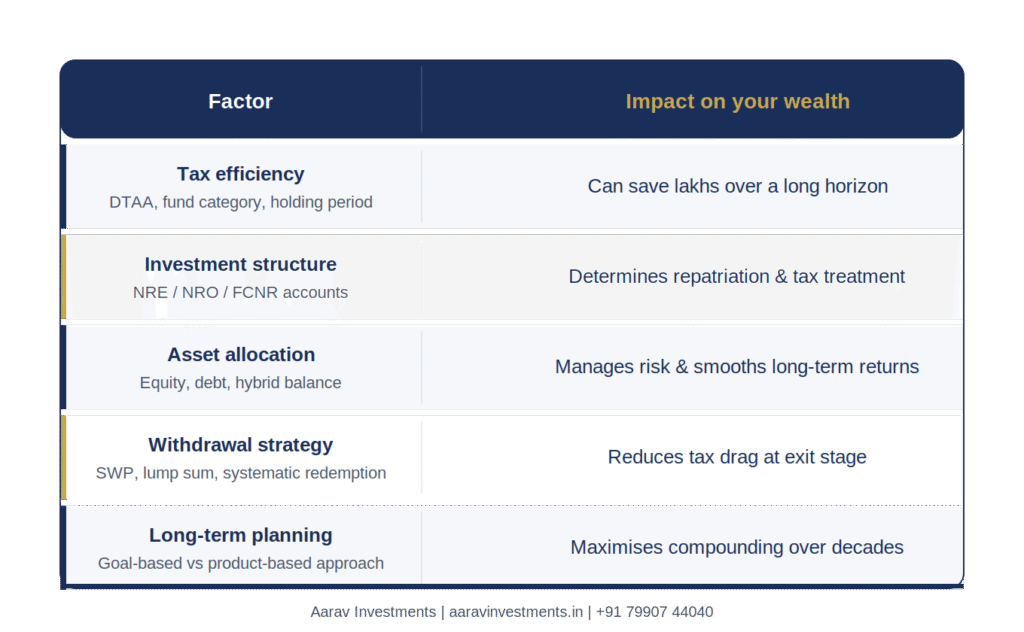
    Two NRI investors with identical portfolios and identical returns can end up with very different post-tax wealth — purely because of how their investments are structured.

    Factors that determine your actual returns:

    For NRIs based in the UK, Germany, USA, Singapore, or the Gulf, each jurisdiction has its own tax treaty with India. The planning approach must be customised, not copy-pasted.


    Key Lessons for Indian Investors (NRI and Resident)

    Even if you are a resident Indian, this case holds lessons worth applying:

    1. Understand Tax Before You Invest

    Taxes can erode a significant portion of your returns if not planned for. Before investing, ask: How will this be taxed when I redeem?

    2. Mutual Fund Category Matters

    Equity funds, debt funds, hybrid funds, and international funds each carry different tax rules. Choosing based only on past returns without considering tax impact is a common and costly mistake.

    3. Documentation Is Half the Battle

    For NRIs, maintaining proper documentation — Tax Residency Certificate, NRE/NRO account records, PAN, KYC — is essential before claiming any DTAA benefit.

    4. Professional Guidance Pays for Itself

    As your investment portfolio grows, financial decisions become more complex. An experienced mutual fund advisor does not just recommend schemes — they help you build a tax-efficient, goal-aligned strategy that stands up to scrutiny.


    NRI Investment Planning in Ahmedabad — Aarav Investments

    At Aarav Investments, we specialise in helping NRI clients from across the world — including the UK, Germany, Singapore, USA, and Gulf countries — invest wisely in India.

    We are an AMFI-registered Mutual Fund Distributor based in Ahmedabad, with over a decade of experience serving NRI families and High Net-Worth investors.

    Our NRI investment services include:

    • NRI mutual fund investment planning — NRE/NRO/FCNR-based strategies
    • DTAA-compliant investment structuring — coordinated with your CA or tax consultant
    • Goal-based portfolio management — retirement, child education, property purchase
    • SIP and lump sum strategies — tailored to your income cycle and country of residence
    • GIFT City investment options for UK and European NRIs
    • NPS and insurance advisory for NRIs building long-term India exposure

    Whether you are just starting your India investment journey or reviewing an existing portfolio, we provide the clarity and structure your wealth deserves.

    📍 Office: 511 Sun Avenue One, Near Shyamal Cross Roads, Ahmedabad – 380015
    📞 Call/WhatsApp: +91 79907 44040
    📧 Email: info@aaravinvestments.in
    🌐 Website: aaravinvestments.in


    Conclusion

    The Singapore NRI ITAT case is not a story about tax avoidance. It is a story about informed, compliant, and well-structured financial planning.

    Smart investors — whether NRI or resident — focus not just on earning higher returns, but on keeping more of what they earn through tax-efficient strategies.

    If you are an NRI looking for a trusted investment advisor in Ahmedabad, or a resident investor wanting to understand how to make your mutual fund portfolio more efficient — we are here to help.

    Book a Free Consultation with Aarav Investments →


    Disclaimer: This blog is for educational purposes only and does not constitute tax or legal advice. Tax laws and DTAA provisions change from time to time. Please consult a qualified tax advisor and your investment advisor for guidance specific to your situation.

  • What is an SWP in Mutual Funds? How It Works, Benefits & Tax Rules (2026)

    What is an SWP in Mutual Funds? How It Works, Benefits & Tax Rules (2026)

    You’ve spent years building your corpus. Now you want that money to come back to you — regularly, predictably, without selling everything at once.

    That’s exactly what an SWP (Systematic Withdrawal Plan) does.

    Whether you’re a retiree in Ahmedabad looking for monthly income, a parent funding a child’s college fees, or simply someone who wants to replace a low-yield FD — SWP is one of the most practical and tax-efficient tools in mutual fund investing.

    In this guide, we break down everything you need to know: what an SWP is, how it works step by step, the real numbers, tax implications in 2026, and when it makes sense for you.


    What is an SWP (Systematic Withdrawal Plan)?

    An SWP, or Systematic Withdrawal Plan, is a facility in mutual funds that allows you to withdraw a fixed amount of money at regular intervals — monthly, quarterly, or annually — while keeping the remaining investment active and compounding.

    Think of it as the reverse of an SIP. With an SIP, you invest a fixed amount regularly. With an SWP, you withdraw a fixed amount regularly.

    Simple definition: You invest a lump sum in a mutual fund. You instruct the fund house to credit ₹10,000 (or whatever amount you choose) to your bank account every month. The fund redeems just enough units to pay you that amount. The rest stays invested and keeps growing.

    SWP is not a new product. It is a feature available on almost every mutual fund scheme in India — from equity funds to hybrid funds to debt funds.


    How Does an SWP Work? (Step-by-Step)

    Here’s exactly what happens behind the scenes every month when your SWP runs:

    Step 1 — You invest a lump sum
    You invest, say, ₹25 lakh in a mutual fund of your choice. This gets converted into units at the current NAV (Net Asset Value).

    Step 2 — You set up the SWP
    You decide:

    • How much to withdraw (e.g., ₹15,000/month)
    • How often (monthly, quarterly)
    • The start date
    • The duration (fixed period or ongoing)

    Step 3 — Units are redeemed automatically
    On your chosen date each month, the fund calculates how many units need to be sold to give you ₹15,000. If the NAV is ₹50, it redeems 300 units. If the NAV has risen to ₹60 next month, only 250 units are redeemed.

    Step 4 — Money hits your bank account
    The proceeds are directly credited to your registered bank account — no manual action needed.

    Step 5 — The rest keeps compounding
    The remaining units stay in the fund, continue to grow with the market, and fund future withdrawals.


    SWP Example with Real Numbers

    Let’s say Rameshbhai, a 58-year-old retired professional from Ahmedabad, invests ₹30 lakh in a balanced advantage fund and sets up an SWP of ₹20,000 per month.

    Month Opening Value NAV Units Redeemed Withdrawal Closing Value
    1 ₹30,00,000 ₹100 200 ₹20,000 ₹29,80,000
    2 ₹30,14,000* ₹101 198 ₹20,000 ₹29,94,000
    3 ₹30,50,000* ₹103 194 ₹20,000 ₹30,30,000

    *Assuming fund grows at ~10% annualised

    When the fund’s growth rate exceeds the withdrawal rate, the corpus actually grows over time — even while you’re drawing income. This is the magic of SWP done right.


    Types of SWP

    1. Fixed Amount SWP
    You withdraw a fixed rupee amount every month. Most commonly used. Best suited for predictable expenses like rent, EMIs, or household costs.

    2. Appreciation-Based SWP
    You withdraw only the gains earned on your investment, keeping the principal intact. Ideal for investors who want income without eroding the original corpus.

    3. Variable SWP
    You can increase or decrease the withdrawal amount based on your financial needs. Offers maximum flexibility.


    SWP vs FD — Which is Better?

    This is the question every investor in Gujarat eventually asks. Here’s an honest comparison:

    Feature SWP (Equity/Hybrid Fund) Bank FD
    Monthly Income Yes Yes (if cumulative, only at maturity)
    Effective Return 10–12% p.a. (historical) 6.5–7.5% p.a.
    Inflation Protection Yes (equity component) No
    Tax on ₹10L corpus income ~Nil (LTCG exemption) As per income slab (up to 30%)
    Flexibility High Low (penalties on premature exit)
    Capital Protection Market-linked Yes (up to ₹5L DICGC)
    Corpus Growth Possible Unlikely after withdrawals

    For most investors above the 20% tax bracket, SWP from an equity-oriented hybrid fund is significantly more tax-efficient than a bank FD.


    SWP Tax Rules in 2026 — What You Need to Know

    This is where most people get confused. Let’s keep it simple.

    Every SWP withdrawal is a redemption of units. It is taxed as capital gains — not as income.

    The FIFO (First In, First Out) rule applies: The oldest units in your portfolio are redeemed first.

    For Equity-Oriented Funds (≥65% in equities):

    • Units held > 12 months → LTCG (Long-Term Capital Gains)
      Tax rate: 12.5% on gains above ₹1.25 lakh per year (Budget 2024 rate, unchanged in 2026)
      The first ₹1.25 lakh of annual LTCG is completely tax-free.
    • Units held ≤ 12 months → STCG (Short-Term Capital Gains)
      Tax rate: 20% flat

    Key insight: Only the gain portion of each withdrawal is taxed — not the entire withdrawal amount. If you withdraw ₹15,000 but only ₹3,000 is gain, you’re taxed on ₹3,000 only.

    For Debt Funds (purchased after April 1, 2023):

    All gains — regardless of holding period — are taxed at your income slab rate. No indexation benefit.

    Practical Tax Example

    Rameshbhai withdraws ₹2.4 lakh over 12 months via SWP from a hybrid equity fund. His total gains from these withdrawals = ₹60,000. Since ₹60,000 < ₹1.25 lakh annual LTCG exemption, his tax on SWP income = ₹0.

    Compare that to the same ₹2.4 lakh from an FD taxed at 30% slab — he’d pay ₹72,000 in tax.


    Who Should Use an SWP?

    SWP is particularly well-suited for:

    Retirees seeking monthly income
    Replace pension or FD income with a tax-efficient, inflation-beating withdrawal stream.

    Parents funding education expenses
    Set up a quarterly SWP to fund college tuition without selling your entire corpus at once.

    Professionals supplementing salary
    Use an SWP to fund EMIs or business expenses during lean months.

    NRI investors with India corpus
    SWP proceeds can be credited to NRE/NRO accounts for easy repatriation (subject to applicable TDS for NRIs).

    Anyone exiting an FD mindset
    If you’re sitting on a large FD renewing every year and paying 30% tax on interest, an SWP migration plan may significantly improve your post-tax income.


    Which Mutual Funds Are Best for SWP?

    Not all mutual funds are equally suited for SWP. Here’s a general framework:

    For stability + income (low to moderate risk):
    Balanced Advantage Funds / Dynamic Asset Allocation Funds — these automatically rebalance between equity and debt, reducing volatility in your corpus.

    For higher growth + long horizon:
    Equity hybrid funds or large-cap equity funds — suitable if your corpus is large and you’re drawing less than 6–7% annually.

    For short-term or conservative needs:
    Arbitrage funds or conservative hybrid funds — these offer predictable, low-volatility returns, ideal for 1–3 year SWP goals.

    Want personalised fund recommendations for your SWP? Our team at Aarav Investments analyses your corpus, risk profile, and tax situation before suggesting a fund.


    How to Start an SWP — 4 Simple Steps

    1. Choose the right fund — based on your risk appetite, corpus size, and withdrawal goal
    2. Invest the lump sum — online through your existing mutual fund account or through a distributor
    3. Register the SWP — specify amount, frequency, and start date
    4. Track annually — review the corpus every year to ensure withdrawals are sustainable

    Common SWP Mistakes to Avoid

    Withdrawing too aggressively
    If your withdrawal rate (annual withdrawal ÷ corpus) exceeds the fund’s long-term return, your corpus will shrink and eventually run out. A safe withdrawal rate is typically 6–8% of corpus per year.

    Choosing the wrong fund
    High-risk sector or small-cap funds are not suitable for SWP — volatility can devastate your corpus if markets fall during withdrawals.

    Ignoring exit loads
    Some funds charge an exit load (typically 1%) on units redeemed within 12 months. Plan your SWP start date to avoid this.

    Not reviewing annually
    Markets change. Your corpus changes. Review your SWP every financial year to ensure the plan remains on track.


    SWP vs IDCW Option — What’s the Difference?

    Many investors confuse SWP with the IDCW (Income Distribution cum Capital Withdrawal) option of mutual funds. They are different.

    SWP IDCW
    Amount control You decide Fund declares (variable)
    Tax Capital gains (often lower) Taxed as income at slab rate + 10% TDS above ₹10,000
    Corpus impact Controlled Can reduce NAV significantly
    Predictability High Low

    SWP is almost always more tax-efficient and more predictable than the IDCW option.


    Frequently Asked Questions (FAQ)

    Q: Can I stop or modify my SWP?
    Yes. You can pause, modify, or stop your SWP anytime — there’s no lock-in or penalty (except exit loads if applicable).

    Q: Is SWP safe?
    SWP from a well-diversified equity or hybrid mutual fund is considered a low-to-moderate risk strategy, especially when the withdrawal rate is conservative (below 7% annually). The underlying fund carries market risk.

    Q: What is the minimum amount for SWP?
    Most fund houses allow SWP of as low as ₹500–₹1,000 per month, though practically, SWPs make most sense for corpus sizes above ₹5–10 lakh.

    Q: Can NRIs use SWP?
    Yes. NRIs can invest in Indian mutual funds and use the SWP facility. Withdrawals are subject to TDS at applicable NRI rates (20% for equity STCG, 12.5% for LTCG). They can file for a refund if TDS is over-collected.

    Q: Is SWP better than a pension plan?
    SWP offers more flexibility and potentially higher returns than most traditional pension plans, but lacks the guaranteed income of an annuity. Many financial advisors recommend a combination of both.


    Final Word: Is SWP Right for You?

    SWP is not a magic formula — it’s a disciplined strategy that works best when paired with the right fund, the right withdrawal rate, and regular annual reviews.

    Done right, SWP can give you monthly income that is more tax-efficient than an FD, potentially inflation-beating, and completely under your control.

    At Aarav Investments, we’ve helped hundreds of families in Ahmedabad — from working professionals in Bopal to retired couples near Shyamal Circle — set up SWPs that are tailored to their life stage, risk appetite, and tax profile.

    If you’re looking for best SWP advisor in Ahmedabad, Gujarat or want to migrate an existing FD corpus into a better structure, let’s talk.


    📞 Call / WhatsApp: +91 79907 44040
    📧 Email: info@aaravinvestments.in
    🏢 Office: 511 Sun Avenue One, Near Shyamal Cross Roads, Ahmedabad – 380015 Location
    🌐 Website: aaravinvestments.in

    Aarav Investments is an AMFI-registered Mutual Fund Distributor with ARN – 264373. Mutual fund investments are subject to market risks. Please read all scheme-related documents carefully before investing.

  • Best Mutual Fund Advisor in Ahmedabad

    Best Mutual Fund Advisor in Ahmedabad

    Best Mutual Fund Advisor in Ahmedabad – Aarav Investments (Abhishek Viramgami)

    Aarav Investments is one of the best mutual fund advisors in Ahmedabad, Gujarat, helping individuals, families, business owners, and NRIs make smarter investment decisions. Led by Abhishek Viramgami, Aarav Investments is an AMFI-Registered Mutual Fund Distributor providing professional guidance in Mutual Funds, SIP Planning, Portfolio Management Services (PMS), Fixed Deposits, Insurance, Pension Planning, Tax-Saving Investments, Retirement Solutions, and NRI Investment Planning.

    With a strong focus on transparent advice and goal-based investment planning, Aarav Investments helps Indian and NRI investors create long-term wealth while managing risk effectively.

    Why Aarav Investments is Among the Best Mutual Fund Advisors in Ahmedabad

    1. Personalized Investment Planning

    Every investor has different financial goals.

    Someone may want to plan for retirement, while another investor may focus on children’s education, wealth creation, financial security, or managing investments in India while living abroad.

    For NRIs, managing Indian investments can become challenging due to distance, changing financial needs, and portfolio monitoring requirements.

    Aarav Investments helps NRI investors with structured investment planning, mutual fund guidance, SIP investments, PMS solutions, and long-term wealth management in India.

    2. Trusted Financial Partner for Families & NRIs

    Building wealth requires patience and consistent decision-making.

    Aarav Investments focuses on developing long-term relationships with resident Indians as well as NRIs by providing:

    • Regular investment guidance
    • Transparent communication
    • Portfolio reviews
    • Goal-based financial planning
    • Support for managing Indian investments from abroad

    Our aim is to make investing simple and convenient whether you are living in Ahmedabad or anywhere across the world.

    3. Complete Wealth Management Solutions

    Aarav Investments provides multiple financial solutions including:

    • Mutual Funds
    • SIP Investment Planning
    • NRI Mutual Fund Investment Guidance
    • Portfolio Management Services (PMS)
    • Fixed Deposits
    • Insurance Planning
    • Pension Planning
    • Tax-Saving Investments
    • Retirement Solutions

    This allows individuals, families, and NRIs to manage different financial needs under one trusted platform.

    Benefits of Working With Aarav Investments

    Complete Financial Guidance

    Whether you need mutual funds, SIP planning, insurance, fixed deposits, PMS, NRI investment solutions, or retirement planning, Aarav Investments provides complete financial planning support.

    For NRIs living in countries like the USA, UK, Canada, UAE, Australia, Africa and other parts of the world, Aarav Investments helps maintain a connection with Indian investment opportunities through professional guidance and regular support.

    Start Your Investment Journey With Aarav Investments

    If you are searching for the best mutual fund advisor in Ahmedabad or a trusted NRI investment advisor in Gujarat, Aarav Investments can help you plan your financial future with confidence.

    Get expert guidance for SIPs, mutual funds, PMS, insurance, fixed deposits, retirement planning, and NRI investment solutions.

    Aarav Investments – ARN – 264373
    AMFI-Registered Mutual Fund Distributor

    📍 511, Sun Avenue One, near Manekbag Society, behind Shreyas Foundation, Ahmedabad, Gujarat 380015

    📞 Call Or Whatsapp: 079907 44040

    Build your wealth with smart investment planning — because your financial goals are our mission.


    📞 +91 79907 44040 | 🌐 aaravinvestments.in | Insta: @aaravinvestments7

  • How to Build a ₹1 Crore Corpus through SIPs in India: Your Roadmap to Financial Freedom

    How to Build a ₹1 Crore Corpus through SIPs in India: Your Roadmap to Financial Freedom

    Are you dreaming of building a substantial financial nest egg? For many Indians, a ₹1 Crore corpus represents a significant milestone towards financial freedom. While it might sound like a daunting sum, achieving this goal is entirely possible, especially with the power of Systematic Investment Plans (SIPs) in India. This comprehensive guide will walk you through everything you need to know about building a ₹1 Crore corpus through disciplined SIP investments.

    What is a SIP and Why is it Ideal for Building Wealth in India?

    A Systematic Investment Plan (SIP) is a method of investing a fixed amount regularly (e.g., monthly or quarterly) into a chosen mutual fund scheme. Instead of making a lump-sum investment, SIPs allow you to invest small, consistent amounts, making wealth creation accessible to everyone.

    Here’s why SIPs are a game-changer for building a ₹1 Crore corpus in India:

    • Rupee Cost Averaging: SIPs help you navigate market volatility. By investing regularly, you buy more units when prices are low and fewer when prices are high, averaging out your purchase cost over time. This reduces the risk of timing the market.
    • Power of Compounding: This is the secret sauce of long-term wealth creation. With compounding, your initial investment and the returns it earns also start earning returns, creating an exponential growth effect. The longer you invest, the more powerful compounding becomes.
    • Discipline and Consistency: SIPs instill financial discipline. By automating your investments, you ensure consistent savings, which is crucial for reaching a large financial goal like ₹1 Crore.
    • Affordability: You can start a SIP with as little as ₹500 per month, making it an inclusive investment option for various income levels.

    The Math Behind a ₹1 Crore Corpus with SIPs

    Let’s get down to numbers. The amount you need to invest monthly to reach ₹1 Crore depends on three key factors:

    1. Investment Horizon (Number of Years): How long are you willing to invest?
    2. Expected Rate of Return: What average annual return do you anticipate from your mutual fund investments? (Historically, equity mutual funds in India have delivered 10-15% annual returns over the long term.)
    3. Monthly SIP Amount: How much can you comfortably invest each month?

    Here’s a table illustrating how different SIP amounts and timeframes can help you reach ₹1 Crore, assuming an average annual return of 12%:

    Monthly SIP Amount Investment Horizon (Years) Total Invested Amount Estimated Corpus (at 12% p.a.)
    ₹10,000 21 ₹25.2 Lakhs ₹1 Crore
    ₹15,000 18 ₹32.4 Lakhs ₹1 Crore
    ₹20,000 16 ₹38.4 Lakhs ₹1 Crore
    ₹25,000 14 ₹42.0 Lakhs ₹1 Crore
    ₹30,000 13 ₹46.8 Lakhs ₹1 Crore

    Note: These are illustrative figures. Actual returns may vary based on market conditions and fund performance.

    Key takeaway: The earlier you start and the longer you invest, the less you need to invest monthly to reach your ₹1 Crore corpus goal.

    Steps to Build Your ₹1 Crore Corpus through SIPs

    1. Define Your Goal and Timeline: Clearly establish that your goal is to build a ₹1 Crore corpus. Decide on a realistic timeline (e.g., 10, 15, or 20 years). This will help you determine the required monthly SIP amount.
    2. Assess Your Risk Tolerance: Equity mutual funds offer higher potential returns but come with higher risk. Understand your comfort level with market fluctuations. If you have a long investment horizon, you can afford to take on more equity exposure.
    3. Choose the Right Mutual Funds:
      • Equity Funds: For long-term goals like ₹1 Crore, equity funds (large-cap, mid-cap, multi-cap, flexi-cap) are generally recommended due to their higher growth potential.
      • Diversification: Don’t put all your eggs in one basket. Diversify across different fund categories and fund houses.
      • Research: Look for funds with a consistent track record, good fund manager reputation, and reasonable expense ratios. Use online research tools and consult with a financial advisor.
    4. Start Your SIPs:
      • Open a Folio: You can invest directly through fund houses or through platforms like your bank, discount brokers, or online aggregators.
      • Automate Payments: Set up automatic debits from your bank account for your monthly SIP installments. This ensures consistency.
    5. Increase Your SIPs Regularly (Step-Up SIP): As your income grows, consider increasing your SIP amount annually. This is known as a Step-Up SIP. Even a small annual increase (e.g., 5-10%) can significantly boost your final corpus due to compounding.
      • Example: If you start a ₹10,000 SIP and increase it by 10% annually, you could reach ₹1 Crore much faster than a static ₹10,000 SIP.
    6. Monitor and Review (But Don’t Over-Monitor):
      • Annual Review: Review your portfolio at least once a year. Check if your funds are performing as expected and if your financial goals or risk profile have changed.
      • Avoid Panic Selling: Market corrections are normal. Don’t stop your SIPs or withdraw investments based on short-term market fluctuations. SIPs thrive on consistency through ups and downs.
    7. Stay Invested for the Long Term: Patience is paramount. The power of compounding needs time to work its magic. Resist the urge to withdraw funds prematurely.

    Important Considerations for Indian Investors

    • Inflation: Remember to factor in inflation when setting your financial goals. A ₹1 Crore today will have different purchasing power in 15-20 years.
    • Taxation: Understand the taxation rules for mutual funds (Capital Gains Tax). Long-term capital gains from equity funds (held for over one year) are currently taxed at 12.5% on gains exceeding ₹1.25 Lakh in a financial year.
    • Emergency Fund: Before you start investing heavily in SIPs, ensure you have an adequate emergency fund (3-6 months of expenses) to cover unforeseen circumstances.
    • Professional Advice: If you’re unsure, consider consulting a SEBI-registered financial advisor. They can help you create a personalized financial plan.

    Conclusion

    Building a ₹1 Crore corpus through SIPs in India is an achievable goal with the right strategy, discipline, and patience. By understanding the power of compounding, investing consistently, and choosing appropriate mutual funds, you can systematically work towards financial freedom. Start early, stay invested, and watch your wealth grow!

    Ready to start your journey towards a ₹1 Crore corpus? Begin your SIP with Aarav Investments today!


    📞 +91 79907 44040 | 🌐 aaravinvestments.in | Insta: @aaravinvestments7

  • Active vs Passive: Which Mutual Fund Strategy Fits Your Investment Style?

    Active vs Passive: Which Mutual Fund Strategy Fits Your Investment Style?

    “Active vs Passive: Which Mutual Fund Strategy Fits Your Investment Style?” 

    The stock market can often feel like a rollercoaster ride—soaring one moment and plunging the next. This inherent volatility makes it tough for many investors to stay committed, especially those seeking consistent returns. As a result, choosing the right investment vehicle becomes one of the most important financial decisions you’ll make. 

    Historically, many turned to actively managed funds, hoping professional fund managers could outperform the market. However, in recent years, this strategy has come under scrutiny. The spotlight has now shifted to index funds—low-cost, passively managed options that aim to mirror market indexes rather than beat them. 

    But which is the better choice: active or passive funds? Let’s explore both to help you determine what suits your investment goals. 

    📘 Understanding the Basics: Index Funds vs. Actively Managed Funds 

    Index funds are mutual funds or ETFs designed to replicate the performance of a specific market index (like the Nifty 50 or Sensex). These funds hold the same securities in roughly the same proportions as the index they follow. 

    Because they require little active oversight, index funds generally come with lower management fees. They’re popular among investors who prefer a hands-off, cost-effective approach to long-term investing. 

    In contrast, actively managed funds involve a team of fund managers and analysts who make real-time decisions about which securities to buy or sell. Their goal is to outperform market benchmarks. 

    While they provide more flexibility and the potential for higher returns, they also come with higher expense ratios due to the active management involved. 

    💡 The Core Differences: Active vs. Passive Investing 

    Criteria  Index Funds (Passive)  Actively Managed Funds 
    Management Style  Follows a fixed index  Professional managers make decisions 
    Cost  Low expense ratios  Higher management fees 
    Performance Goal  Match the market  Beat the market 
    Risk Level  Lower (market-linked)  Higher (depends on strategy) 
    Diversification  Broad market exposure  Varies based on fund focus 

    🧠 When Does Passive Investing Make Sense? 

    Index funds are ideal for: 

    Long-term investors with a low-risk appetite 

    Those who want minimal involvement in day-to-day investment decisions 

    Individuals looking for low-cost, tax-efficient investments 

    Benefits include: 

    Lower fees 

    Simple portfolio management 

    Exposure to a wide market or sector 

    However, index funds might underperform in bullish markets or during times when specific sectors or companies are outperforming. 

    🏦 When Might Active Management Be Worth It? 

    Actively managed funds are more suitable for: 

    Investors seeking potentially higher returns 

    Those who trust fund managers to make tactical decisions 

    Individuals with a moderate to high-risk tolerance 

    Benefits include: 

    Potential to beat market returns 

    Customized portfolio strategies 

    Greater focus on emerging sectors or undervalued stocks 

    But these advantages come at a cost—and success heavily depends on the manager’s expertise. 

    📉 Downsides to Consider 

    Index Funds: 

    Limited flexibility 

    No ability to respond quickly to market changes 

    May not align with personal investment preferences 

    Active Funds: 

    Higher fees can eat into returns 

    Performance isn’t guaranteed and may lag behind benchmarks 

    Heavily dependent on fund manager’s skill 

    🧾 Final Thoughts: Which Should You Choose? 

    There’s no one-size-fits-all answer. The best choice depends on your financial goals, investment horizon, and risk tolerance. For some, the simplicity and reliability of index funds are perfect. For others, the potential rewards of active funds make the added costs worthwhile. 

    In many cases, a hybrid approach works best—combining both types of funds to build a well-diversified portfolio that balances risk and reward. 

    Key Takeaway: 
    Know your goals, assess your comfort with risk, and choose a fund type—or combination—that supports your financial journey. 


    📞 +91 79907 44040 | 🌐 aaravinvestments.in | Insta: @aaravinvestments7

  • Form 15G and Form 15H – why you must file to save TDS

    Understanding Form 15G and Form 15H: A Comprehensive Guide

    In the realm of taxation in India, there are several forms and documents that individuals need to be familiar with to comply with the regulatory requirements. Two such forms are Form 15G and Form 15H, which are used to declare that an individual’s income is below the taxable limit and hence, not subject to TDS (Tax Deducted at Source). In this article, we will delve into the details of these forms, their purpose, eligibility criteria, and the process of submitting them.

    Form 15G and Form 15H are valid for one financial year. So, please submit these forms every year at the beginning of the financial year. This will ensure that the bank does not deduct any TDS on your interest income.

    Form 15G and Form 15H: An Overview:

    Form 15G and Form 15H serve the same purpose but cater to different categories of taxpayers. They are primarily meant to prevent the deduction of tax at source on certain types of income for individuals who are not liable to pay taxes on their total income. The forms act as self-declaration forms to be submitted to the payer (bank, financial institution, or any other entity responsible for making the payment).

    Form 15G is applicable to individuals below the age of 60 years, Hindu Undivided Families (HUFs), trusts, or any other non-corporate entities. On the other hand, Form 15H is specifically designed for senior citizens (individuals aged 60 years or above). By submitting these forms, eligible individuals can prevent tax deduction at source on their interest income, dividends, or other income sources, subject to specific conditions.

    Eligibility Criteria:

    To avail the benefits of Form 15G or Form 15H, individuals must meet certain eligibility criteria, including:

    1. Form 15G: a. The individual should be a resident Indian. b. The individual’s age must be below 60 years (in the case of individuals and HUFs). c. The total estimated income for the financial year should be below the taxable threshold.

    2. Form 15H: a. The individual should be a resident Indian. b. The individual’s age must be 60 years or above during the financial year. c. The estimated tax liability for the financial year should be nil.

    It is important to note that these forms need to be submitted separately for each financial year and for each payer, depending on the income received from them.

    Submission Process:

    The process of submitting Form 15G or Form 15H is relatively straightforward. Here are the steps to follow:

    1. Obtain the relevant form: Form 15G and Form 15H are readily available on the websites of banks, financial institutions, or can be obtained from income tax offices.

    2. Fill in the necessary details: Carefully fill in the required details such as name, address, PAN (Permanent Account Number), previous assessment year, estimated income, etc.

    3. Attach supporting documents: In some cases, supporting documents such as a photocopy of PAN card or identification proof may be required. Ensure that these documents are attached as per the instructions mentioned in the form.

    4. Submit the form: Once the form is duly filled and signed, submit it to the respective payer or deductor responsible for deducting tax at source.

    5. Retain a copy: It is advisable to keep a copy of the submitted form for future reference.

    Conclusion:

    Form 15G and Form 15H provide individuals an opportunity to avoid TDS on their income if they fall within the prescribed eligibility criteria. These forms play a crucial role in reducing the administrative burden on taxpayers who are not liable to pay taxes on their total income. However, it is important to ensure that the information provided in these forms is accurate and in compliance with the income tax regulations. It is recommended to seek professional advice or consult the income tax department


    📞 +91 79907 44040 | 🌐 aaravinvestments.in | Insta: @aaravinvestments7

  • Why you should start ELSS SIP in April Month?

    Why you should start ELSS SIP in April Month?

    Starting an Equity-Linked Saving Scheme (ELSS) through a Systematic Investment Plan (SIP) in April has several benefits. Here are a few reasons why:

    The financial year begins in April: The financial year in India starts from April 1st and ends on March 31st of the following year. By starting an ELSS SIP in April, you can align your investment with the financial year, making it easier for you to plan and track your investments.

    Time in the market: By starting your ELSS SIP in April, you give your money more time to grow. Over the long term, equity investments tend to perform well, but they can be volatile in the short term. Starting your SIP in April gives you a head start and more time in the market to benefit from the power of compounding.

    Tax benefits: ELSS funds offer tax benefits under Section 80C of the Income Tax Act, 1961. By starting an ELSS SIP in April, you can spread your investments over the entire financial year and make the most of the tax benefits available to you.

    Rupee cost averaging: Investing through an SIP allows you to benefit from rupee cost averaging. By investing a fixed amount at regular intervals, you buy more units when the market is down and fewer units when the market is up. This helps you to average out the cost of your investment over time.

    Overall, starting an ELSS SIP in April can be a smart way to begin your tax-saving and long-term investment journey. However, it’s important to do your own research and consult with a financial advisor to make sure it’s the right investment option for you.
    Contact us to meet and understand the best ELSS funds that can deliver superior returns over the long team.


    📞 +91 79907 44040 | 🌐 aaravinvestments.in | Insta: @aaravinvestments7